Chapter 4 from the book “The Milner-Fabian Conspiracy” by Ioan Ratiu, 2012. Download in Word format.
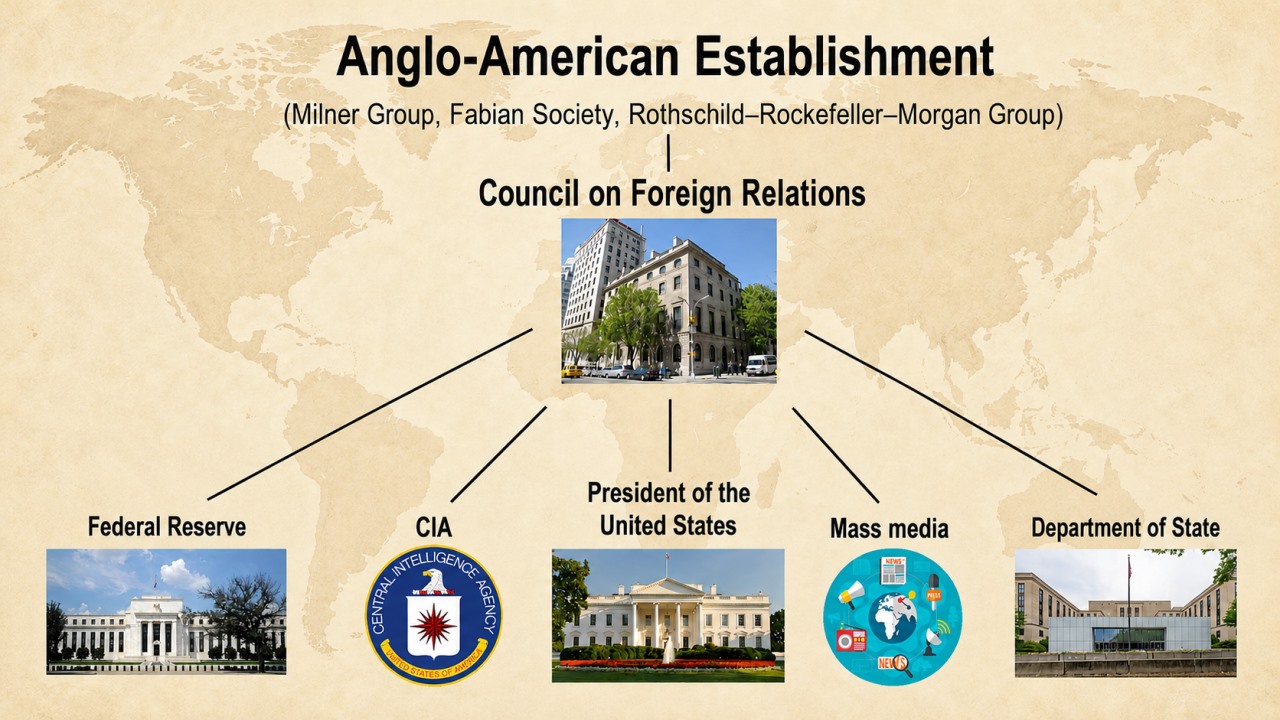
The Council on Foreign Relations (CFR) is the New York-based sister organization of the Royal Institute of International Affairs (Chatham House), established as a continuous conference on international questions affecting the United States (Rockefeller, p. 406).
However, its critics have described it as “invisible government” (Smoot, 1962) and as a “society which believes that one-world rule should be established” (Quigley, 1966).
Contents
- The origins of the CFR
- The CFR and Socialism
- The CFR and the Federal Reserve
- The CFR and US foreign relations
- The CFR and World Government
- The MI6-CFR-CIA Connection
- The CFR, Multiculturalism and Islamization
- Note
- References
The origins of the CFR
Birth of the Milner Group
On 5 February 1891, Cecil Rhodes, the founder of leading diamond company De Beers, formed The Society of the Elect in London, for the purpose of “extending British rule throughout the world” and uniting Great Britain with the United States (Quigley, 1981, pp. 3, 33-38). The Society later came to be known by various names at various times, including “the secret society of Cecil Rhodes”, “the Round Table Group”, and “the Milner Group” (Quigley, 1981, pp. 3, 4, 39, 311).
Rhodes’ secret society was clearly intended as an invisible world government. Equally clear is that “British rule” did not mean the rule of the British people, or even of the British government, but the rule of the international financiers behind the Society, who were as much at home in Cape Town, Paris, Frankfurt or New York as they were in the City of London and who intended to pursue their aim of world domination by “secret political and economic influence behind the scenes” (Quigley, 1981, p. 49).
Indeed, the Society achieved the exact opposite of British rule, namely the dissolution of the British Empire and Britain’s subordination to organizations like the League of Nations (LON), the United Nations (UN) and the European Union (EU), representing (not very British) international money interests.
How this came about is suggested among other things by the composition of the Society’s leadership. Its inner core (“Circle of Initiates”) included:
• Lord Nathan (“Natty”) Rothschild of the London private investment bank N. M. Rothschild & Sons, who was Rhodes’ financier and trustee, major De Beers shareholder and a governor of the Bank of England;
• diamond magnate Alfred Beit, founder of the British South Africa Company (BSAC), governor of De Beers and manager of Rhodes’ business affairs;
• diamond magnate Abraham (“Abe”) Bailey, the Society’s chief financial supporter;
• Reginald Baliol Brett (later Lord Esher), friend and adviser to Queen Victoria and former Liberal MP;
• and Alfred Milner (later Lord), private secretary to former Bank of England director Lord Goschen. Milner also became a director of the Rothschild controlled mining company Rio Tinto. Although he described himself as an “English nationalist”, Milner was in fact a notorious Socialist (Quigley, 1981; Sutton, 1974).
Birth of the Morgan Group, the American equivalent of the Milner Group
In a parallel movement across the Atlantic, on 20 February 1891, the American John Pierpont Morgan founded the elite Metropolitan Club of New York with headquarters on the 60th Street. Morgan was a partner and later head of America’s No. 1 private investment bank Drexel, Morgan & Co. (later J. P. Morgan & Co.) of New York, with branches in London and Paris. He was also an agent for European investment in the USA and Rothschild representative with links to the Rothschilds dating from 1835 (Mullins, p. 54).
The Metropolitan’s original members included railway magnate William K. Vanderbilt and James Alfred Roosevelt of the investment bank Roosevelt & Son, an uncle of US President Theodore Roosevelt (www.metropolitanclubnyc.org). The Roosevelt’s had long-standing close links to the Morgan, Vanderbilt and Astor groups. Emlen Roosevelt of the Astor National Bank of New York, which was controlled by Morgan partner Thomas W. Lamont, was Theodore Roosevelt’s financial adviser (Burch, Jr., vol. 2, p. 188; vol. 3, p. 21).
Other key figures associated with British interests were Jacob H. Schiff and August Belmont.
Jacob Schiff was the head of America’s No. 2 private investment bank Kuhn, Loeb & Co. of New York, and a Rothschild representative. Schiff’s father, Moses, had already been an associate of the Rothschild banking firm in Frankfurt, Germany (Encyclopaedia Judaica, vol. 14, p. 961) and his family’s close connections with the Rothschilds went back to the 18th century (Mullins, pp. 57, 87).
August Belmont was the head of the private investment bank August Belmont & Co. of New York, and a Rothschild representative. His father, August (Schönberg) Belmont Sr., had been an employee of the Rothschilds’ banking firm in Frankfurt, and a representative of their interests in the US as well as Democratic Party Chairman (Encyclopaedia Judaica, vol. 14, p. 342; Ferguson, 2000, vol. 2. pp. 65-7).
The Birth of the Anglo-American Establishment
J. P. Morgan and associates, August Belmont, Jacob Schiff, etc., belonged to the so-called “Eastern Establishment” (Quigley, 1966, p. 950), America’s financial and academic elite based on the East Coast, especially in New York and Washington, D.C. The Morgan Group, in particular, formed the New York counterpart to London’s Milner Group (Quigley, 1966, p. 953) and the two groups formed part of what Carroll Quigley has called “the Anglo-American Establishment” (pdf, html).
It should be noted that, given the establishment’s close connections with France (through the Rothschild, Lazard, Morgan and Fabian groups), a more accurate denomination would be “Anglo-Franco-American Establishment”. For the sake of convenience, however, the present study preserves Professor Quigley’s phrase.
Morgan Group Network of Organizations
Like the Milner Group in Britain, the Morgan Group created a network of interlocking organizations connected with international relations. Among these were the:
• Pilgrims Society, with branches in London and New York established in 1902 and 1903, respectively, by Schiff and Belmont in collaboration with New York lawyer Lindsay Russell (whose firm Alexander & Colby acted as counsel for the Morgans’ Southern Railway Co.);
• the American Society of International Law (ASIL), organized in 1906 by former US Minister to Turkey (later Secretary of Commerce) Oscar Solomon Straus and Secretary of State Elihu Root;
• the Japan Society of New York, founded by Schiff, Belmont and Russell in 1907;
• and the foreign-policy think tank Carnegie Endowment for International Peace (CEIP), established in 1910 by former steel magnate Andrew Carnegie (who had sold his business to Rothschild agent J. P. Morgan) with Elihu Root as president.
In June 1918, the Metropolitan formed an informal group called the Council on Foreign Affairs which held regular meetings at its 60″ Street premises to discuss international relations. The Council’s chairman was Lindsay Russell, president of the Japan Society. The Council’s honorary chairman was CEIP president Elihu Root. The board of directors included Oscar S. Straus and former US Ambassador to Turkey Henry Morgenthau, Sr. who had been on Woodrow Wilson’s 1912 presidential campaign team (“Plan International Forum”, New York Times, 4 Jun. 1918).
Establishment of the Anglo-American Institute of International Relations
During the 1919 Peace Conference of Paris, the Society of the Elect, now led by Rhodes’ friend and successor Lord Milner and hence known as “the Milner Group”, in collaboration with Fabian Society members and the Morgan Group conceived an Anglo-American organization called the Institute of International Affairs.
The Institute was organized under the leadership of Lionel Curtis, a prominent member of the Milner Group. Among Fabians involved were R. H. Tawney, John Maynard Keynes (Martin, p. 175) and Philip Noel-Baker (Quigley, 1981, p. 183), as well as Fabian collaborators/sympathizers like LSE Professor Arnold J. Toynbee who became Chatham House Director of Studies and Lord Astor (son of the 1st Lord Astor), a leading Milnerite who was also a friend of the Fabian leadership.
The Institute’s American group included brothers John Foster Dulles and Allen Dulles of the Wall Street law firm Sullivan & Cromwell (who were nephews of President Wilson’s Secretary of State, Robert Lansing), Christian Herter of the US State Department and General Tasker Bliss, US representative, Inter-Allied Supreme War Council.
Among those providing funds to the Institute were: J. P. Morgan & Co., the Carnegie Trust and J. D. Rockefeller, as well as various institutions with Milner Group members on their board of directors, such as the US car maker Ford Motor Company, the Bank of England, Lazard Brothers & Co. of London and N. M. Rothschild & Sons (Quigley, 1981, p. 190).
The creation of Chatham House and the CFR
The British branch of the Institute was founded in London in 1920 and became the Royal Institute of International Affairs (RIIA or Chatham House) in 1926. It later became known as Chatham House after the building housing its headquarters.
The American branch of the Institute initially failed to take off due to the US Senate’s opposition to the internationalist schemes of President Woodrow Wilson, the Institute’s chief American supporter. But in July 1921, those associated with the Anglo-American Institute of International Affairs merged with (according to Quigley, 1981, p. 191, “took over”) the Morgan Group’s Council on Foreign Affairs. The new organization was named the Council on Foreign Relations (CFR) and held the first meeting of its directors on 28 September 1921.
The CFR’s current headquarters at Harold Pratt House, 58 East 68th Street, New York City, was acquired in 1929 with funds provided by the Rockefellers (Smoot, p. 7).
Influential members of the CFR
As conceded by leading CFR member David Rockefeller, the CFR’s proceedings were dominated by New York businessmen, bankers and lawyers (Rockefeller, p. 407). A selected list of 1921 founding directors makes it clear whose interests they represented:
Honorary president: Elihu Root, a Morgan lawyer and front man (Quigley, 1966, p. 53). As already noted, Root was president of the Carnegie Endowment for International Peace and former honorary chairman of Morgan’s Council on Foreign Affairs.
President: John W. Davis, another Morgan man (Quigley, 1966, p. 53). He was former Ambassador to Britain and partner at the New York law firm Davis, Polk & Wardwell, a Morgan representative, as well as a trustee of the Rockefeller Foundation (Collier, p. 134).
Vice-president: Paul D. Cravath, of the New York law firm Cravath, de Gersdorff, Swain & Wood, a Kuhn, Loeb representative.
Secretary & treasurer: Edwin F. Gay, former Harvard Professor of Economic History and president of the New York Evening Post.
[Harvard was a Morgan-controlled university. J. P. himself had been a generous donor and received an honorary Master of Arts degree from Harvard. Harvard president Charles W. Eliot backed Morgan’s candidate Wilson for presidency in 1912. J. P. Morgan partner Thomas W. Lamont was the chairman of the Harvard Endowment Fund Committee and member of the board of directors of Harvard’s daily paper, The Crimson.]
The SMO also included such influential figures as:
John Huston Finley, former New York State Commissioner of Education and associate editor of the Morgan-controlled New York Times.
[The Milner Group also controlled the International Conciliation, the Herald Tribune, the Christian Science Monitor and the Washington Post (Quigley, 1966, p. 953); in Britain, it controlled or had influence on The Times, The Round Table, The Economist, the Spectator and other publications (Quigley, 1981, pp. 138, 161, 260).]
Whitney H. Shepardson (CFR treasurer, 1933-42), a Milnerite and Rhodes scholar, member of Wilson’s team at the 1919 Paris Peace Conference, who later became head of the Office of Strategic Services (OSS) Secret Intelligence Branch [* from which the CIA was created after the war].
Frank L. Polk (CFR vice-president, 1940-43), partner of Davis, Polk & Wardwell, later director of Morgan-controlled Chase National Bank.
Isaiah Bowman (CFR vice-president, 1945-49), director of the American Geographical Society and former member of the executive committee of President Wilson’s Inquiry.
[Wilson himself was a Morgan front man. In 1902, he became President of Princeton University with the help of his old classmate and director of the Morgan-controlled National City Bank, Cleveland Dodge (Sutton, 1995, p. 82) and had a private dinner with the Morgans at his home to celebrate his installation as president next day.
Princeton University, controlled by the Milner Group, later established the Institute for Advanced Study, similar to All Souls College at Oxford University (Quigley, 1966, p. 953).
Wilson supported Morgan during the 1907 financial crisis and Morgan, along with his Rockefeller-Schiff associates, backed Wilson’s 1912 presidential campaign. The largest single contributor to the Wilson campaign was Cleveland Dodge (Sutton, 1995, p. 83). Another Morgan associate who backed Wilson was Colonel George Harvey of Harper’s Weekly (Smith, p. 41).]
Bowman was also a member of the British Royal Geographical Society (Parmar, p. 40) and geographical societies on both sides of the Atlantic were involved in “exploration”, especially in connection with discovering and obtaining information on natural resources like oil.
Paul Moritz Warburg, of Kuhn, Loeb, member and later president of the Federal Reserve Board Advisory Council (see below).
Otto H. Kahn, of Kuhn, Loeb — from CFR Historical Roster of Directors and Officers (Smoot, pp. 153-5; www.cfr.org).
The above list clearly exposes the CFR as an operation created and dominated by the Milner-Morgan Group and other Rothschild associates.
The Warburgs, of Hamburg, Germany, had close connections with the Rothschilds going back to the early 1800s. In the 1890s, Max Warburg did his apprenticeship at N. M. Rothschild in London before becoming director of his family’s banking house M. M. Warburg (Ferguson, 2000, vol. 2, p. 234). In 1902, his brother Paul Moritz moved to New York where he became a partner at Kuhn, Loeb, which was run by his brother-in-law Jacob Schiff, a Rothschild agent.
J. P. Morgan and Kuhn, Loeb were also long-time Rothschild representatives. The Rothschilds remained close to the Morgans and Kuhn, Loeb long after the creation of the CFR.
In 1938, Louis von Rothschild of S. M. von Rothschild & Sohne of Vienna, transferred the rights of disposal over all his Austrian assets to Kuhn, Loeb (Ferguson, 2000, vol. 2, p. 471). In the 1940s and 50s, Edmund (“Eddy”) and Leopold (“Leo”) de Rothschild and Jacob (later Lord) Rothschild of London did their apprenticeship at (Morgan-controlled) Guaranty Trust, Morgan Stanley and Kuhn, Loeb (Ferguson, 2000, vol. 2, pp. 480, 483).
The CFR has always had a large number of J. P. Morgan & Co. partners, associates and employees on its board of directors and its relationship with its British counterpart Chatham House (RIIA) has been very close (Quigley, 1981, p. 191).
Its main financial supporters have been various Rockefeller foundations and funds as well as the Rockefeller-associated Carnegie and Ford foundations which between them control enormous resources (Kutz, 1974). Their financial contributions have enabled the CFR to become a very powerful organization (Smoot, pp. 7, 34).
The CFR and Socialism
The Milnerite creators of the CFR aimed to establish a Socialist style dictatorship headed by a self-appointed administrative or technocratic elite (the Milner Group itself) (Quigley, 1981, pp. 130-1). This aim is hinted at in Colonel Edward M. House’s book, “Philip Dru Administrator: A Story for Tomorrow 1920-1935″ (1912).
Edward M. House, intimate friend and adviser to President Wilson was a left-wing radical who believed that the American Constitution was “thoroughly outdated” and should be scrapped (Smith, p. 23). House and his collaborators organized a meeting during the 1919 Paris Peace Conference, which led to the creation of the CFR and Chatham House.
Their sponsorship of Socialism and revolution, therefore, was a logical consequence of their aims (if the Milner Group ever opposed Socialism, it was only the kind over which they had no control).
The Milner Group and the Fabian Society are financing the revolution in Russia
During the Russo-Japanese War of 1904-05, the Rothschilds’ US representative, Jacob Schiff and his bank, Kuhn, Loeb, sided with the Japanese, providing them with a loan of $200 million (£41 million) (Encyclopaedia Judaica, vol. 14, p. 961). The Rothschilds, who specialized in government loans, also participated in this loan (Ferguson, 2000, vol. 2. p. 396). At the same time, Schiff and the Rothschilds blocked loans to Russia. The overall result was that in 1905 Russia was plunged into revolution.
In 1907, Lord Rothschild (of Rothschild, London) and his cousin Edouard de Rothschild (of Rothschild Fréres, Paris), issued similar loans to Japan, one of them in the amount of £23 million ($112 million) (Smethurst; Ferguson, 2000, vol. 2, p. 396).
As noted earlier, while Schiff and the Rothschilds provided loans to Japan, industrialist and millionaire Joseph Fels of the Fabian Society — an organization with close links to the Rothschilds — provided a substantial loan, in addition to pocket money, to Lenin, Trotsky and their Russian Social Democratic Labour Party (later Communist Party) during their 1907 London conference (Rappaport, pp. 153-4; Martin, pp. 29, 161; Cole, p. 113, see also Joseph and Mary Fels Papers, The Historical Society of Pennsylvania, Collection 1953; www.hsp.org).
In February 1917, the Tsar was overthrown by the revolutionary government of Alexander Kerensky (a leading member of Russia’s Socialist-Revolutionary Party) and the way was paved for Lenin’s Communist gang to take over later that year.
Historical evidence shows that Schiff had something to do with this outcome. He had financed a revolutionary propaganda campaign against Russia’s legitimate Tsarist government (through the New York Society of the Friends of Russian Freedom), funded armed groups in Russia and supported Alexander Kerensky’s revolutionary government with a substantial loan (Encyclopaedia Judaica, vol. 14, p. 961). In fact, the Rothschilds themselves loaned a million roubles to Kerensky’s revolutionary government in 1917 (Ferguson, 2000, vol. 2. p. 448).
Professor Sutton (1974, p. 197) seems to believe that Schiff was “not interested in supporting the Kerensky Liberty Loan”. The evidence (see above) shows that Schiff did loan money to Kerensky and that the Rothschilds themselves participated in Kerensky’s Liberty Loan as well as in the earlier Japan loans which contributed to the fall of the Tsars.
Moreover, in March 1917, Schiff sent a message of deep regret for his inability to celebrate with the Society of the Friends of Russian Freedom (SFRF) “the reward of what we had hoped and striven for these long years”. The SFRF was celebrating the Russian Revolution at Carnegie Hall.
Schiff’s message was read out by George Kennan (cousin of historian George F. Kennan) who had close links to Kerensky’s Socialist-Revolutionary Party and was a leading SFRF member. Earlier during the meeting, Kennan related how the Schiff-funded SFRF had spread “the gospel of the Russian revolutionists” among thousands of members of the Russian forces (“Pacifists Pester Till Mayor Calls Them Traitors”, NYT, 24 Mar. 1917).
For British involvement in see note at end of chapter. [*]
[*] Му note.
The role of the British ruling class in organizing the socialist and communist revolutions in Russia in 1917 is detailed in Richard Poe’s study, “How the British Invented Communism” (2023).
End of my note.
The Rothschilds’ other representatives, the Morgan Group, in collaboration with the Rockefellers and their associates were similarly involved in left-wing projects like:
- the Chinese Revolution of 1911-1912,
- the Mexican Revolution of 1910-20
- and the Russian Revolution in February and October 1917 (Sutton, 1974, pp. 51, 125).
In November 1917, William Boyce Thompson of the Federal Reserve Bank of New York (controlled by the Rockefeller-Kuhn Loeb and Morgan groups through their National City and First National Banks) contributed $1 million to the Russian Communist leadership (Sutton, 1974, pp. 18, 125, 170).
Thompson’s American Red Cross Mission to Russia, Charles R. Crane of Westinghouse Electric (financed by Kuhn Loeb & Co), the Morgan-controlled Guaranty Trust Co. and others were all involved in Russia at various times during and after the 1917 Revolution (Sutton, 1974, pp. 171; 26-7, 193; 170).
The Rockefellers’ Standard Oil and the Morgan-controlled Chase National Bank (taken over by the Rockefellers in 1930) conducted business with Communist Russia since the 1917 Revolution (de Villemarest 1996, p. 242).
The above activities, including Schiff’s creation in 1907 of the Japan Society, must be seen as the background on which the CFR-RIIA global network emerged.
Woodrow Wilson, US President from 1913 to 1921, and his friend and adviser Colonel House, who according to some sources was an agent for the London House of Rothschild with which he was linked through banking and cotton interests (Martin, p. 160), were instrumental in the formation of the Anglo-American Institute of International Affairs.
Wilson was a Democrat and political theorist who advocated centralized power and who believed that “in fundamental theory socialism and democracy are almost if not quite one and the same” (“Socialism and Democracy”, 1887). As pointed out by Rose Martin, Wilson’s book, The New Freedom, sought to equate the Democratic Party with the Social democracy of the British Fabians (Martin., p. 149). Morgan-Rockefeller-Schiff backing for Wilson clearly exposes their left-wing political allegiance.
The original Council on Foreign Affairs (later CFR) itself was formed just weeks after the creation by the same interests, of the American League to Aid and Cooperate with Russia (1 May 1918) which aimed to do business with Lenin’s and Trotsky’s Communist regime (Sutton, 1974, p. 154). Its honorary chairman was Morgan man Elihu Root, president of the pro-Socialist CEIP and head of the 1917 Root Mission to Russia, while Oscar S. Straus, vice-president of the American League to Aid and Cooperate with Russia, was a member of its board of directors.
The Council on Foreign Relations’s left-wing political orientation
The CFR’s political orientation is indicated among other things by statements such as that of CFR Chairman Peter G. Peterson who in the Council’s 1997 annual report conceded that there was “a kernel of truth” to the charge that the CFR was an organization of “New York liberal elite” (Marrs, p. 33).
How liberal, i.e., left-wing, the organization is, emerges from the fact that left-winger Hamilton Fish Armstrong was editor of the CFR journal Foreign Affairs, while his close friend, Fabian Socialist Walter Lippmann, was one of the journal’s first contributors and CFR foreign-policy expert (Steel, pp. 204, 236).
In particular, David Rockefeller, America’s chief Corporate Socialist, wrote a thesis on Fabian Socialism at Harvard and spent his second post-graduate year at the Fabian London School of Economics (Rockefeller, p. 75). From 1949, he has been a director, chairman (1970) and honorary chairman (1985) of the CFR.
The CFR also has a long history of associating itself with Socialist-infiltrated or Socialist-dominated organizations like the Foreign Policy Association (FPA), the Institute of Pacific Relations (IPR) and the National Council of Churches (NCC) (Smoot, p. 314).
The same interests, represented by the Laura Spelman Rockefeller Memorial, the Rockefeller Foundation and associated outfits, have also funded influential Anglo-American left-wing institutions and organizations like the Fabian Society’s London School of Economics which alone received millions of dollars, for which reason it became known as “Rockefeller’s baby” (Martin, p. 309; Rockefeller, p. 81; Dahrendorf, p. 164).
With all their support for Socialism, ultimate power in the Milnerite scheme was of course to remain in the hands of the international financiers (Sutton, 1974, p. 175) whose fortunes, power and influence were above state control and who professed social “equality”. This has in fact been the case throughout modern history, including in Communist Russia where Milnerite interests were allowed to carry on doing business as usual (see here, p. 199).
The CFR and the Federal Reserve
There has been much speculation about the links between the US central banking or Federal Reserve system (FRS) and the Anglo-American Establishment. Some authors have sought to settle the matter by insisting that the Federal Reserve is a “U.S. government institution” which is “not owned by any private entities” and that “the Rothschilds have nothing to do with it” (Foxman, p. 138).
However, this assessment is not entirely accurate.
In the first instance, as pointed out by the economist Professor Antony Sutton on the evidence of Federal Reserve vice-chairman Alan Blinder, decisions taken by the Fed “cannot be changed by Government or anyone else”, in which case the Fed cannot really be a “government institution” (Sutton, 1995, p. 114).
Secondly, Sutton also points out that “the Federal Reserve is a private system with private stockholders” (Sutton, 1995, p. 66).
Indeed, the Federal Reserve may or may not be a government institution, but it is a well-known fact that shares of the twelve Federal Reserve Banks which make up the system are owned by member banks (Fox & others, p. 12) or, as stated by the FR website, “the reserve banks issue shares of stock to member banks” (http://www.federalreserve.gov/fags/about_14986.htm).
From inception, these member banks, e.g., National City and First National (later Citibank) and Chase National (later JPMorgan Chase), New York, which elect the directors of the regional FR banks, were controlled by private interests such as the Morgan and Rockefeller groups and continue to be controlled by them. Even taking into account that member banks have only one vote in the election of regional FR bank directors, their influence remains considerable.
In 1912, an official investigation (“Pujo Committee“) found that J. P. Morgan & Co. partners held 72 directorships in 47 of the country’s largest corporations in addition to owning large shares of stock in the National City and First National banks, which in turn owned stock in other large banks (de Saint-Phalle, p. 52).
It goes without saying that smaller corporations are influenced by the larger ones which dominate the industry and with which they come into direct or indirect contact. Given the growing concentration of power in the hands of a few large corporations, this influence can only have increased over time.
Thirdly, as regards the Rothschild connection, the fact is that the very idea of a central bank was a European concept and that the US Federal Reserve was conceived on the model of privately-owned European institutions, such as the Bank of England and the German Reichsbank and following discussions with officials of those institutions (Broz, pp. 175-6; Sutton, 1995, p. 76).
As is well known, the Bank of England had close historical connections with the Rothschilds. Moreover, the Rothschilds had a well-documented history of involvement in various official initiatives designed to “stabilize” American finances in the 1870s and 1890s (Ferguson, 2000, vol. 2, p. 348; Bernstein, p. 275). It therefore seems counterintuitive that the Rothschilds should have had “nothing to do” with the Federal Reserve project.
Interestingly, a Federal Bank was founded in New York in 1902 by the brothers David and Louis Rothschild. It was closed down by the government only two years later and the exact identity of the interests behind the operation or, indeed its true objectives, remains a mystery (“Federal Bank Closed And Inquiry Started”, NYT, 15 Apr. 1904).
What is certain is that the European Rothschilds operated in America and elsewhere through agents and partners they knew and trusted, like the Belmonts, the Schiffs, the Warburgs and the Morgans (Ferguson, 2000, vol. 2, pp. 115, 348, 396). These Rothschild agents and partners were involved in the Federal Reserve project at all stages.
For example, Jacob Schiff of Kuhn, Loeb and Paul Warburg, also of Kuhn, Loeb, called for a central bank in 1907. Warburg, in particular, was a staunch advocate of a central banking system and one of the chief architects of legislation establishing the Federal Reserve (Encyclopaedia Judaica, vol. 16, p. 282; Sutton, 1995, p. 79).
It was Warburg and his collaborator Benjamin Strong, vice-president of the Morgan-controlled Bankers Trust of New York, who as advisers to Senator Nelson Aldrich (John D. Rockefeller’s father in law) persuaded the latter of the “need” for a centralized system (Broz, p. 175).
As noted above, President Woodrow Wilson’s adviser, Colonel House himself, who was involved in the Federal Reserve Act of 1913, has been identified by historians as a Rothschild agent (Martin, p. 160). House also selected the first Federal Reserve Board, including Rothschild associate Paul Warburg (Smith, p. 78).
In their turn, Rothschild associates Morgan and Kuhn, Loeb nominated Benjamin Strong for the post of first governor of the Federal Reserve Bank of New York (Quigley, 1966, p. 326), which later became the dominant bank in the Federal Reserve.
Influence on or control of the FRS by private interests must be beyond dispute since representatives of the said interests are sitting on the bodies which control it, i.e.:
- the Board of Governors,
- the Federal Open Market Committee (FOMC)
- and the Federal Advisory Council (FAC).
The Federal Reserve Board of Governors and private financial interests
For example, early members of the Board included Paul Warburg and Eugene Meyer (of Lazard Frères & Co). Later Board chairmen have included individuals who were or later became members of the CFR and CFR-dominated organizations, such as: Marriner S. Eccles (member of the CFR-dominated Commission on Money and Credit), Thomas B. MacCabe (CFR), Arthur F. Burns (CFR) and, more recently, CFR members Paul A. Volcker (1979-1987) and Alan Greenspan (1987-2006).
It may be noted that, like David Rockefeller, Volcker was a graduate of Harvard and LSE, Trilateral Commission member and economist at Chase Manhattan Bank. Rockefeller was also a director of the New York Federal Reserve Bank and was succeeded by Volcker as its president.
Other New York Fed directors also had close links to Chase Manhattan. At any rate, the fact that the Federal Reserve Board is dominated by regional banks like the New York Fed — which are controlled by private interests — was acknowledged by various authorities from Board chairman Eccles (Burch, vol. 3, p. 41) to the Congressional Committee on Banking (Aug. 1976, 94″ Congress, 2™ session, in Sutton, 1995, p. 66).
In addition, as members of the Board are appointed by the US President, it is not difficult to see how elements of the Anglo-American Establishment may infiltrate the system with the assistance of government executives with links to the same interests.
For example, in the 1990s, the Clinton administration which was bankrolled by CFR member and Rothschild associate George Soros proposed CFR member Felix Rohatyn for the post of vice-chairman of the Fed Board. Rohatyn was a long-standing Lazard partner who later worked at Rothschild North America (the US subsidiary of N. M. Rothschild, London) before returning to Lazard (Financial Times, 9 May 2007). Although the proposal was rejected by the Republicans, it illustrates how the system can be used by private interests and their political collaborators for their own agenda.
In the event, Clinton in 1996 re-appointed as Fed chairman CFR member Alan Greenspan who was former chairman of the Council of Economic Advisers (CEA), a former director of J. P. Morgan & Co. and Mobil Corporation, as well as a friend of Rohatyn, David Rockefeller and Henry Kissinger (Greenspan, p. 81).
In turn, Greenspan’s friends were friends and associates of the Rothschilds (through outfits like the Bilderberg Group, the Trilateral Commission, etc.). All of which clearly identifies Greenspan as a trusted member of the same establishment.
Significantly, the previous year, Clinton had nominated James Wolfensohn for the post of World Bank president. Wolfensohn (who is also a CFR member) was a partner of former Fed chairman Paul Volcker and Jacob Rothschild in J. Rothschild, Wolfensohn & Co.
It follows that the links between the Federal Reserve Board and private financial interests are sufficiently strong to warrant legitimate concern (hence the Congressional investigation mentioned above). Moreover, as the chairman of the Board traditionally served as chairman of the Open Market Committee, this has further strengthened the influence of private interests on the FR system.
Similarly, the Advisory Council consisted of representatives of the private banking industry. Thus, in addition to being a member of the Board, CFR member and Rothschild associate Paul Warburg served as member and later president of the Advisory Council. Another prominent member of the Advisory Council in the early days was Rothschild agent J. P. Morgan, Jr. himself.
The Federal Reserve and International Financial Interests
As the banks involved, from Kuhn, Loeb and J. P. Morgan to Lazard, had and continue to have close links to foreign banks (like N. M. Rothschild and the Bank of England), this is further evidence of the Fed’s links to international financial interests.
Moreover, member banks holding FR stock, which have long become multinational corporations, remain under the control of the same international interests. For example, the CEO of Citigroup (of which Citibank is a subsidiary) from 2007 to 2012 was Vikram Pandit, a director of the Rockefeller-associated Columbia University, while the president of the Rockefeller Foundation, Judith Rodin, became an independent director of Citigroup in 2004.
In addition, as in Britain and elsewhere in Europe, elements of the Anglo-American Establishment have become official advisers to the US Government itself — as evident from the recent advisory role played by Rothschild Inc. and associates in the restructuring of Chrysler and General Motors (Reuters, 18 Dec. 2009; www.rothschild.com/usa/).
On balance, it becomes evident that the Anglo-American Establishment is in a position to influence not only the Federal Reserve, but also the US Government and the Treasury Department which handles the profits made by the Fed. Moreover, although the Fed in theory is subject to congressional oversight, as pointed out by former FBI officer Dan Smoot, through interlocking organizations the CFR is able to put pressure on Congress to support its policies (see below).
Indeed, the Anglo-American Establishment’s close international connections must have some bearing on the degree and direction of influence it exerts, given that this is their express intention. For example, N. M. Rothschild’s European advisory council, which aims to “promote the Rothschild message”, has included influential figures like senior Lazard partner Michael Gottschalk; long-time Bank of England governor Sir Edward George; and Klaus Mangold of DaimlerChrysler AG (The Times, 17 October 2003; Financial Times, 23 May, 2005).
The Federal Reserve and financial crises
Finally, Fed policies are of particular interest as they enable us to verify the claim that the Fed’s purpose, even “duty”, is to maintain the stability of the US financial system, maintain stable prices and contain risks in the financial markets. As this claim is best tested in a crisis, we note that there have been various major crises such as:
- the Wall Street Crash of 1929,
- Black Monday of 1987
- and the current financial crisis which began in 2007.
The Fed was clearly unable or unwilling to prevent any of these.
A more interesting question for the purposes of the present discussion, however, is whether the Fed (and the money power behind it) has played any role in the creation of these crises. Some believe that it has.
A number of analysts have noted that under Alan Greenspan the Fed cut interest rates, which resulted in cheap costs of borrowing, which resulted in an inflated housing market, which enabled speculators like Roland Arnall of Ameriquest and Argent Mortgage to play havoc in the subprime mortgage market, which triggered the banking and financial crisis.
The chain of culpability then, as some have pointed out, runs from Capitol Hill with the policies devised at Washington’s Federal Reserve Bank to Manhattan’s Wall Street chief executives, while former Fed Chairman Alan Greenspan is sitting at the top of the blame tree (Jagger, 2008).
The crisis led to the collapse of many banks, enabling JPMorgan Chase to buy up Bear Stearns, Bank of America to take over Merrill Lynch, etc. As noted by the Financial Times, 21 of the 25 top subprime mortgage originators were owned or financed by the likes of J P Morgan, Bank of America and Citibank which were the largest political donors in Washington (Luce, 2009). As we now know, these banks were also key members of the Rothschild-Rockefeller-dominated Anglo-American Establishment.
These banks — with J.P. Morgan in the lead — had also been active in the much larger credit derivative market which they were able to create and dominate thanks to the Financial Services Modernization Act engineered by Fed president Greenspan and his collaborators from the Treasury Department, Robert Rubin and Lawrence Summers.
Despite creating havoc in the financial markets, the same banks were able to vastly increase their power and influence, received billions of dollars in government bailouts and had their executives appointed in advisory roles to government and business.
All this exposes the Fed as a fraudulent system controlled by private interests who use their connections to government and their access to public funds to further their own agendas and tighten their stranglehold on society and the world.
The CFR and US foreign relations
Already in January 1921, the ex-president of the Rockefeller-controlled National City Bank of New York and president of the Schiff-Belmont Japan Society, Frank A. Vanderlip, had proposed the “formation of a Council of Foreign Relations to direct American intercourse with foreign nations”.
According to Vanderlip, while the US President must initiate treaties and may still appoint the Secretary of State as well as ambassadors and ministers, their confirmation should be “in the hands of the Council of Foreign Relations” (“Vanderlip Plans A Super Senate”, NYT, 23 Jan. 1921).
In May 1923, Vanderlip restated the aims of the financial interests he represented, by advocating less control by the President and Secretary of State in foreign affairs (“Asks Council to Run Our Foreign Affairs”, NYT, 13 May 1923).
The above statements make the Council’s original intention absolutely clear, namely to transfer political power to a private organization that was not accountable to either the American people or the American Government.
From 1922, the CFR has published the quarterly magazine Foreign Affairs which aims “to guide American opinion” and is, informally, the “voice of the US foreign-policy establishment”. Ideas put forward in the magazine “appear later as US government policy and legislation” (New Encyclopaedia Britannica, vol. 4, p. 877).
In 2009 and 2010 the “Global Go to Think Tanks” Report by the University of Pennsylvania (published in Foreign Policy and The Economist) named RIIA (Chatham House) the most influential think tank outside the US, and CFR the second most influential in the US after Brookings Institution (www.sas.upenn.edu).
Needless to say, Brookings is controlled by the same interests: one of its presidents was Trilateral Commission member and president of the CEIP, Bruce King MacLaury (Sutton & Wood, p. 27).
David Rockefeller, a long-time leading member of the CFR, has openly admitted that the CFR continues to play an influential role in the formulation of American foreign policy to this day (Rockefeller, p. 408).
How the CFR shapes US Foreign Policy
The CFR has influenced US foreign policy by various well documented means such as:
1. Using the CFR research facilities to develop “scientific” arguments in support of policies it wants the US Government to adopt (Schlafly & Ward quoted in Marrs, p. 35).
2. Dominating the State Department which it infiltrated with CFR members and into which it was incorporated in the early 1940s (Smoot, p. 8; Parmar, p. 3).
3. Manipulating public opinion through a wide network of interlocking propaganda organizations, chief among which are outfits like the Foreign Policy Association (FPA).
The FPA started its subversive existence in 1918 as the League of Free Nations Association (LFNA), the American counterpart to Britain’s Operation of the same name. While the British LFNA was set up by leading Milnerites and Fabians like Herbert G. Wells and Gilbert Murray, its American clone was set up by Felix Frankfurter and Paul Warburg (Winkler, p. 71; Smoot, pp. 31, 34).
From the early days, the FPA collaborated particularly closely with the Institute of Pacific Relations, a Communist front with which it had interlocking personnel and which specialized on Asia. It has also operated through a nationwide web of Councils on World Affairs aiming to “inform” unsuspecting citizens on international affairs and foreign policy (Smoot, pp. 34, 36).
4. Using public opinion, etc., as above, to put pressure on Congress to support CFR policies (Smoot, p. 31).
5. Dominating the US Committee for the UN and other groups involved in planning and establishing the UN (Smoot, p. 103; Parmar, pp. 124-5).
6. Exerting influence or control over the academics involved in international relations and their study by financing universities, professorships, scholarships, etc. through organizations like the Carnegie and Rockefeller foundations (Parmar, p. 4). It may be recalled in this context that David Rockefeller himself was on the board of overseers at Harvard University in the 1950s and 60s as has been a friend of Harvard presidents like Nathan Pusey.
7. Last but not least, the CFR and the interests behind it also exert influence or control over US presidents and presidential candidates by financing and directing their electoral campaigns (see Woodrow Wilson, Bill Clinton, Barack Obama), acting as presidential advisers (see Kissinger et al.), etc.
The CFR and World Government
The creators of RIIA (Chatham House) and the CFR, such as Lionel Curtis and Alfred Zimmern, were internationalists who openly advocated world government (Parmar, p. 72).
The international financial interests associated with the CFR and RIIA and centred on financial institutions like the Bank of England and the New York Federal Reserve Bank similarly aimed to establish a world system of financial control concentrated in private hands (Quigley, 1966, pp. 324 ff.).
The globalist designs of these groups are evident from the international network of interlocking organizations they have set up. Between 1927 and 1936, branches of RIIA were established in Canada, Australia, New Zealand, South Africa, India and Newfoundland (Quigley, 1981, p. 191).
RIIA branches outside the English-speaking world were established between 1935 and 1977 in France, Sweden, the Netherlands, Denmark, Belgium, Pakistan, China, Germany, Russia, Japan, Norway, Italy and many other countries (de Villemarest, 2004, vol. 1, pp. 19-20).
The Milner Group and the League of Nations
In addition to the above network the Milner Group and its associates like the Morgan-Rockefeller groups established the League of Nations (LON) in 1919. Milnerite involvement in the League is evident from the leading role played by Milner Group members and collaborators in both the formation and management of the League.
- Members involved in drafting the League Covenant included Lord (Robert) Cecil, General Jan Smuts, Lord Phillimore and Alfred Zimmern.
- Delegates to the League Assembly included Lord Cecil and Lord Astor.
- Among those holding high positions in the League Secretariat were Sir Eric Drummond (collaborator), Harold Butler, Arthur Salter and Benedict Sumner (Quigley, 1981, pp. 250, 257-8).
- On the American side were George Louis Beer, Elihu Root, Walter Lippmann, Allen Dulles, Colonel Edward M. House and many others.
It is useful to note that although the original professed intention had been to make Britain the centre of a world empire, this was gradually replaced by the idea of transforming the British Empire into a “Commonwealth of Nations” and then placing that system within a League of Nations (Quigley, 1981, p. 137). The same applied to America which, as observed by CFR critics, was to be incorporated into a worldwide Socialist system (Smoot, pp. 9, 31).
CFR, Milner Group and the founding of the UN
Following America’s rejection of the League, the same interests began working for the construction of a new international organization, the United Nations (UN). As with the League, the involvement of these interests in the creation and management of the UN has been amply documented by many researchers. A significant role in the creation of the UN was played by leading CFR member Isaiah Bowman who prepared the final memorandum at the 1944 Dumbarton Oaks Conference (Parmar, p. 123).
As pointed out by Dan Smoot, over 40 CFR members were members of the 1945 UN Conference at San Francisco where the UN Charter was written. They included:
- Secretary of State Edward R. Stettinius;
- CFR co-founder and future Secretary of State John Foster Dulles;
- future Governor of New York and US Vice-president Nelson Rockefeller;
- future President of the World Bank John Jay (“Jack”) McCloy;
- Secretary-General of the UN Conference and Director of the US Office of Special Political Affairs (OSPA) Alger Hiss; etc. (Smoot, p. 8).
On the British side there were prominent Milner Group members like General Smuts (a member of the Inner Circle) who wrote the preamble of the UN Charter (Mazower, p. 61).
Basically, the UN has been exposed as an organization run by Socialists and international financiers belonging to the groups described above (see Ch. 6, The UN Scam). The same applies to the various agencies and associated organizations of the UN.
For example, World Bank presidents, who are traditionally US nationals, have included Eugene Meyer, former chairman of the Federal Reserve Board of Governors; Eugene R. Black, Sr., vice-president of Chase National Bank; Robert McNamara, of Ford Motor Company; and Lewis T. Preston, of J. P. Morgan. All were CFR directors.
The World Bank provides loans to governments, which has given it an unprecedented degree of influence on world affairs. World Bank president John J. McCloy of the Rockefeller-associated New York law firm Milbank, Tweed, Hadley & McCloy, became High Commissioner for Occupied Germany, and was responsible for the creation of the German state after the war (McCloy also became chairman of Chase National Bank and CFR, as well as adviser to a string of US presidents).
CFR, the Bilderberg Group and the Trilateral Commission
Other key instruments of world government created by the CFR and the money interests behind it are the private and semi-secret organizations, the Bilderberg Group and the Trilateral Commission.
The Bilderberg Group was created in 1954 by Fabians Joseph Retinger, Hugh Gaitskell and Denis Healey, in collaboration with David Rockefeller.
The Trilateral Commission was founded in 1973 by David Rockefeller, who acted as chairman, and his friend and collaborator Zbigniew Brzezinski of Columbia University, as founding North American director.
In 1970, Brzezinski had written a book entitled Between Two Ages: America’s Role in the Technetronic Era, in which he declared that national sovereignty was no longer viable and advocated a movement towards a larger, global community, shaped by an international hub like the Trilateral Commission.
Trilateral Commission (TC) members have included European politicians like former French President Giscard d’Estaing, who drafted the EU Constitution; leading British Fabian Socialist and EU Trade Commissioner Peter Mandelson; and (from 2010) leading Spanish Socialist, Javier Solana, former NATO Secretary-General, Secretary-General of the European Council and High Representative for the Common Foreign and Security Policy of the European Union (which chairs the EU Foreign Affairs Council).
As indicated above, the Trilateral Commission has also included financiers like Federal Reserve chairman Alan Greenspan, who are also CFR members and participants in Bilderberg conferences.
Edmond de Rothschild, president of the French-Swiss private banking group Edmond de Rothschild, was Trilateral Commission member as well as a member of the Bilderberg steering committee. Another participant in Bilderberg meetings has been Sir Evelyn de Rothschild (“The first cousins of banking: Men in the News Evelyn de Rothschild and David de Rothschild”, FT, 12 Jul. 2003).
The Trilateral’s and Bilderberg’s connections with the Rothschilds, who were involved with the Milner Group (Society of the Elect) from the start, demonstrates the global reach of the groups involved.
In collaboration with the CFR, these outfits control international organizations through which they influence or control foreign governments. For example, key posts in the International Monetary Fund (IMF) — which operates in association with the World Bank and the UN — are held by members of the CFR and the Trilateral Commission (see Ch. 6, The UN Scam). In addition, they control key media corporations through which they can influence both public opinion and government policy.
CFR members have been chairmen, presidents, directors, editors, analysts, correspondents and publishers in a number of media corporations and outlets including New York Times, New York Post, New York Herald Tribune, Business Week, Newsweek, The Christian Science Monitor, Washington Post, Times Herald, etc. (Smoot, pp. 128-9).
Similarly, from the beginning, many Trilateral Commission served as directors of media outfits such as CBS, Dow Jones, Time-Mirror Corp., Media General Inc., National Education TV, Time, and New York Times (Sutton & Wood, p. 26).
The MI6-CFR-CIA Connection
The Milner Group and its Morgan-Rockefeller associates have always been very close to the intelligence services. Britain’s foreign intelligence agency, the Secret Intelligence Service (SIS) a.k.a. MI6, was an interdepartmental service of the Foreign Office, the Admiralty and the War Office, all of which were run by the interlocking Cecil Bloc and Milner Group.
MI6 was created in 1909 by a committee chaired by Milnerite War Secretary Richard Haldane. Its first chief was Mansfield Cumming who was appointed by Foreign Office Under-Secretary Sir Charles Hardinge, a protégé of Cecil Bloc founder Robert Gascoyne-Cecil (Lord Salisbury).
MI6 establishes its branch in the United States
In 1940, the Milner Group, now headed by Lionel Curtis, was again in charge of the Foreign Office which controlled MI6. While Lord Halifax was Foreign Secretary, his fellow Milner member, Lord Lothian, was British Ambassador to the US.
As part of the Milner Group’s global expansion, MI6 set up an American station, called the British Security Co-ordination (BSC). This organization which was responsible for operations in the entire western hemisphere was headquartered in the New York Rockefeller Center and was run by William Stephenson.
MI6 chief William Stevenson lays the foundations of the CIA
In 1941, Stephenson set up the Office of the Coordinator of Information (COI), which coordinated different US intelligence services and, as adviser to President Roosevelt, had his collaborator William Donovan appointed as head.
In 1942, COI became the Office of Strategic Services (OSS). After the war, in 1947, the OSS was reorganized as the Central Intelligence Agency (CIA) (Jeffrey, pp. 440-9).
The CIA, therefore, was a Milner-CFR creation and part of MI6’s global network. Banker Allen Dulles (younger brother of CFR and UN co-founder John Foster Dulles) was its first director. Most CIA directors have been CFR members ever since (Smoot, pp. x, ff.).
In 1943, David Rockefeller himself became a member of the US Joint Intelligence Collection Agency (JICA) in French North Africa, where he was in touch with Henri Chevalier, general manager of Rockefeller’s Standard Oil interests and set up his own intelligence network there (Rockefeller, pp. 112-3).
Rockefeller’s personal involvement and the fact that by then German forces had been pushed out of North Africa suggests that such intelligence operations revolved around oil interests more than anything else.
The CFR, Multiculturalism and Islamization
The Anglo-American establishment and control of Global Culture
Through the worldwide funding of educational and cultural institutions, the Milner and Morgan-Rockefeller groups and their associates control not only international politics, but also culture which is now becoming global as a result of the activities of the above interests.
In 1942, leading CFR member Paul G. Hoffman, former president of the Ford Foundation and later director of the Special UN Fund for Economic Development (SUNFED), founded the influential think tank, the Committee for Economic Development (CED).
CED subsidiaries like the College-Community Research Centers and Joint Council on Economic Education reached into public schools, colleges and communities throughout the US. Their effort was supervised by the CED’s Business-Education Committee which was run by influential CFR members with links to the financial interests behind the CFR network. One of its members was Walter Rothschild, president of the Abraham & Straus department store chain (Smoot, pp. 51-63).
On a larger scale, the enforcement of a global culture to suit the above interests has taken place through international organizations like the UN Educational, Scientific and Cultural Organization (UNESCO).
UNESCO is the cultural agency of the UN and was created in 1945 to promote “international collaboration” through education, science and culture.
In fact, UNESCO was the successor to the Milner-Fabian International Committee on Intellectual Cooperation (CICI), the advisory body to the League of Nations’ Intellectual Cooperation Organization (ICO), which along with the CICI executive agency, the International Institute of Intellectual Cooperation (IIIC), was used by the Milner Group and its associates to coordinate their international operations from the 1920s (Quigley, 1981, p. 193-4).
The Marshall Plan and the establishment of control over Europe
In 1948, CFR members William L. Clayton and George F. Kennan launched the European Recovery Programme (ERP) a.k.a. Marshall Plan, which was ostensibly intended to “reconstruct Europe”.
In reality, the Plan was based on David Rockefeller’s 1947 report, “Reconstruction in Western Europe,” prepared by the CFR study group, and its true goal was to establish total control over Europe.
The intelligence services on both sides of the Atlantic, which were controlled by these groups, have played key roles in this process. A key plank in the Marshall Plan was the cultural reconstruction of Europe on Milner-CFR lines.
CIA and MI6 operations for the Socialist reformation of Europe
In the early 1950s, the CFR-controlled CIA and MI6 set up the Congress for Cultural Freedom (CCF) which aimed to bring about the “cultural reconstruction” (i.e., Americanization) of Europe through “information, education, orientation, agitation”. The CCF was run by CIA officer Michael Josselson and was funded by the Office for Policy Coordination using “Marshall Aid” moneys (Dorril, p. 477).
Another CIA-MI6 cooperative operation was the British Society for Cultural Freedom [* chapter of the Congress for Cultural Freedom]. It received funds from the Fairfield Foundation (a CIA front) and Lord Victor Rothschild, a former MI5 officer with close links to MI6 (Dorril, pp. 480-1), who was related to prominent Fabian Beatrice Webb through his wife Teresa (“Tess”) Mayor, Beatrice’s niece.
Although such operations were ostensibly designed to “combat the spread of Communism”, they invariably used left-wing activists for this purpose (Callaghan, p. 202). This inevitably strengthened the hand of the Socialist Left (Labour) which, like the Communists, aimed to abolish private property and impose state control over economy and society!
The CIA-MI6 combine also sponsored:
• the International Confederation of Free Trade Unions (ICFTU) which was associated with the Fabian Society’s Socialist International;
• and the World Assembly of Youth (WAY) (Dormil, p. 470) whose British branch, the British Youth Council (BYC), was later chaired by the likes of Peter Mandelson — a leading figure in the Fabian Society’s youth wing, Young Fabians, and later architect of “New Labour“.
Funding Left-wing and Multiculturalist projects
The Rockefeller and Ford Foundations (key fronts through which Milner and Morgan-Rockefeller interests channeled funds for their projects like RIIA-CFR) provided millions of dollars for similar initiatives which were run in collaboration with leading Fabian Socialists like Roy Jenkins, who later became Fabian Society chairman and Labour Home Secretary, and Chatham House councilor Denis Healey (Callaghan, p. 201-2).
The Milner created CFR was also strongly involved in left-wing projects promoting African-American interests, like the US National Association for the Advancement of Colored People (NAACP) and, particularly, the American Committee on Africa (ACOA) which supported anti-white agitators and revolutionaries in South Africa (Smoot, p. 124).
At the same time, dozens of front organizations, publications like Encounter (funded by Victor Rothschild), and endless “artistic events” in collaboration with the BBC and other Milner-Fabian controlled outfits were responsible for the systematic spread of jazz music, Negro Spiritual and other elements of African-American culture, transforming British and European culture beyond recognition.
What becomes clear is that the treacherous Milner Gang which had started off claiming to intend to impose British culture on the world actually ended up imposing foreign cultures on Britain!
The Milner Group, the Fabian Society and Multiculturalism
Inevitably, multiculturalism became a key element in the construction of this secret service-imposed new world culture.
The idea of multiculturalism was first introduced by leading Milner Group member John Buchan (Lord Tweedsmuir), Governor-General of Canada. In the 1930s, Buchan claimed that “the strongest nations are those that are made up of different racial elements”. By the 1960s, multiculturalism had become official policy in Canada.
This idea was supported by the Fabian Society. It was actively promoted by Fabian leaders such as Home Secretary Roy Jenkins, who became one of the architects of multiculturalism and resulting Islamization in the UK.
CFR and Islamization
Other European nations fared no better. While British society was being ethnically-enriched by tens of thousands of South Asians and West Indians, the Administration of US President J. F. Kennedy (a CFR member) in 1961 forced Germany to accept Turkish “guest-workers”, who, over time, created a 4 million strong Muslim colony, contributing in no small measure to the systematic and deliberate Islamization of Europe.
Kennedy’s “special adviser” at the time was CFR foreign relations “expert” Henry Kissinger, who was working for the Rockefellers and clearly represented Rockefeller and associated oil interests in the Middle Fast.
In the same year, Kennedy appointed John McCone, a CFR director and shareholder in the Rockefellers’ Chevron, head of the CIA. The latter, CIA in collaboration with MI6, funded the Egyptian Muslim Brotherhood (Curtis, p. 88) and backed the Saudi regime which was funding the Brotherhood and other Islamist outfits. Again, the reason behind this was oil interests.
The Anglo-American establishment preferred to do business with Islamic fundamentalists as opposed to more secular, but also more independent-minded, Arab nationalists (Foreign Office, “Possible Change of Regime in Saudi Arabia”, Feb. 1964, PRO, FO371/174671 in Curtis, p. 91).
Another key CFR member (in fact, chairman) in the US administration was John MacCloy, a long-time Rockefeller associate and representative of their oil interests, who served as presidential adviser to Kennedy and subsequent US leaders.
In the 1970s, the CFR’s domination of the US State Department enabled the interests behind it, notably the Rockefellers’ ARAMCO (consisting of oil giants Exxon, Texaco, Mobil and Chevron), in collaboration with the US government and the Saudi royal family, to engineer the oil “crisis” resulting in soaring oil prices and unprecedented Western dependence on Arab investments and loans (see Ch. 10, Islamization).
The CFR, the CIA, MI6 and Islamic terrorism
In the 1980s, in collaboration with the British-created Pakistani Inter-Services Intelligence (ISI), the CFR-controlled CIA and MI6 were responsible for recruiting, training and funding the anti-Soviet elements in Afghanistan who later became al-Qaeda and the Taliban (Curtis, pp. 143, 149).
In the 1990s, in collaboration with the German Federal Intelligence Service (BND) and al-Qaeda, CIA-MI6 set up the “Kosovo Liberation Army” (KLA) in Serbia and supplied it with satellite telephones to pass on details of Serbian targets to NATO bombing squads (Curtis, pp. 238-244).
The bombing of Serbia was conducted under NATO Secretary-General Javier Solana, a Spanish socialist, collaborator and future member of the Trilateral Commission.
At the same time, left-wing billionaire and CFR-Bilderberg member George Soros, who has been described as a front man for Anglo-French Rothschild banking interests [*], in collaboration with Harvard’s Gene Sharp, launched a campaign to overthrow Serbia’s anti-Islamist President Slobodan Milosevic, using the local rent-a-mob “resistance movement” (Horowitz & Poe, pp. 232-4).
[*] My note.
Details of how the Rothschild clan created its “golem” George Soros are outlined in the following articles:
- William Engdahl, “The secret financial network behind vizard George Soros” (November 1, 1996);
- Scott Thompson “George Soros: a Golem made in Britain” (August 29, 1997);
- Jeffrey Steinberg, “George Soros: the Queen’s drug pusher” (August 29, 1997).
End of my note.
CFR and the Islamization of the Europe
Both the CFR and its offshoot, the Trilateral Commission (TC), have backed the Milner-Fabian (i.e. Rothschild-Rockefeller) Euro-Mediterranean Project a.k.a. “Union for the Mediterranean” (UfM) which aims to bring about the unification of the European Union with Islamic North Africa and the Middle East.
In the summary of its 9 November 2008 meeting in Paris, the Trilateral Commission (Europe) praised the Mediterranean Union/UfM project as a “model for the World” (www. trilateral.org).
CFR and the Islamization of the United States
Indeed, while America has no geographical proximity to the Muslim world, Islam is steadily advancing on American soil thanks to the efforts of left-wing organizations directly or indirectly linked to CFR/TC interests and their global Islamization programme.
In his excellent exposé of Islamist tactics, Robert Spencer relates that in December 2005 Harvard University received millions of dollars from Prince Alwaleed bin Talal, a nephew of Saudi Arabia’s King Fahd, for an Islamic studies department (Spencer, p. 240).
But this is not the whole story. A more complete version is that Saudi Arabia’s Islamist rulers have long-time connections with Rockefeller interests and so has Harvard. Rockefeller’s Chase Manhattan Bank has served as personal bank to members of the Saudi royal family (Rockefeller, p. 265).
Similarly, bin Talal is a shareholder in Rockefeller-CFR-controlled Citigroup Inc., whose former executive Robert E. Rubin is a member of Harvard Corp., the university’s executive board.
In September 2007, Harvard’s investment group Harvard Management Company, which is likewise controlled by Rockefeller-CFR-TC elements like Jack Meyer of the Rockefeller Foundation and Mohamed El-Erian of IMF, invested hundreds of millions of dollars in the Middle East North Africa (MENA) Fund, a project of EFG Hermes, a Middle Eastern private investment bank, which also funds the European Union’s MU/UfM scheme.
Spencer also relates how, in 2008, John Esposito of Georgetown University in collaboration with the Gallup World Poll published the book Who Speaks for Islam? What A Billion Muslims Really Think, which seeks to project the Muslim world as “moderate” and “pro-democracy” (Spencer, pp. 243-4). Again, it may be added that Gallup was founded by CFR member George Gallup.
In light of these and other related facts, it is not entirely surprising that one of the key organizations responsible for the Islamization of America — sponsored by bin Talal — calls itself the “Council on American-Islamic Relations (CAIR)”.
Note
Although, superficially, it may have seemed contrary to British interests to support revolution in Russia and risk a Russian withdrawal from the war, closer analysis shows that such a risk was minimal.
Indeed, Russia’s new, Socialist-Revolutionary Government with Kerensky as War Minister continued Russian participation in the Allied war effort as a matter of “revolutionary honour” as well as for fear of having Allied financial assistance stopped (N. Sukhanov, The Russian Revolution, 1917, 1955, pp. 202-3; A. Tooze, The Deluge: The Great War and the Remaking of Global Order, 2014, p.70).
By the time Lenin’s Bolshevik regime took the country out of the war America’s entry on the Allied side had rendered Russian contribution dispensible. At any rate, it must be beyond dispute that
(a) there was a strong anti-Tsarist movement sponsored by the Anglo-American Establishment on both sides of the Atlantic and that
(b) it contributed in no small measure to the overthrow of the Tsar.
As Stephen Graham, Lord Northcliffe’s correspondent for the Establishment organ The Times, put it: “The events in Russia will come as a greater surprise to the millions there than to us in England …. Indeed, British public opinion has helped a very great deal to bring about the success of the [anti-Tsarist] movement” (“Causes of the Revolution”, The Times, 17. Mar. 1917).
Apart from a preoccupation with “progress”, the Anglo-American Establishment clearly saw the Tsar as an obstacle preventing it from expanding its control over Russian resources and finance. See also p. 271.
References
Bernstein, Peter L. The Power of Gold: The History of an Obsession, New York, 2000.
Broz, J. Lawrence, The International Origins of the Federal Reserve System, Ithaca, NY, 1997.
Burch, Philip, H., Jr., Elites in American History, 3 vols., New York, NY, 1980-81.
Callaghan, John, The Labour Party and Foreign Policy: A History, Abingdon, Oxon, 2007.
Cole, Margaret, The Story of Fabian Socialism, London, 1961.
Collier, Peter & Horowitz, David, The Rockefellers: An American Dynasty, London, 1976.
Curtis, Mark, Secret Affairs: Britain’s Collusion with Radical Islam, London, 2010.
Dahrendorf, Ralf, A History of the London School of Economics and Political Science, 1895-1995, New York, NY, 1995.
De Saint-Phalle, Thibaut, The Federal Reserve: An International Mystery, New York, NY, 1985.
De Villemarest, Pierre, A l’ombre de Wall Street. Complicités et financements soviéto-nazis (In the Shadow of Wall Street: Soviet-Nazi Collaboration and Financing), Paris, 1996.
De Villemarest, Pierre, Facts & Chronicles Denied To The Public, vols. 1 & 2, 2003; English trans. Slough, Berkshire, 2004.
Dorril, Stephen, MI6: Fifty Years of Special Operations, London, 2001.
Encyclopaedia Judaica, 16 vols., Jerusalem, 1971.
Ferguson, Niall, The House of Rothschild, 2 vols., New York, NY, 2000.
Fox, Lynn S. & others, The Federal Reserve System: Purpose & Functions, 9 edition, Washington, DC, 2005.
Foxman, Abraham H., Jews and Money: The Story of a Stereotype, New York, NY, 2010.
Greenspan, Alan, The Age of Turbulence: Adventures in a New World, London & New York, NY, 2007.
Horowitz, David & Poe, Richard, The Shadow Party, Nashville, TN, 2006.
Jagger, Suzy, “Who caused this nightmare? Blame tree has branches in every direction — The banking crisis”, The Times, 19 Mar. 2008.
Jeffrey, Keith, MI6: The History of the Secret Intelligence Service 19091949, London, 2010.
Kutz, Myer, Rockefeller Power, New York, NY, 1974. See also Lundberg, Ferdinand, The Rich and the Super Rich, New York, NY, 1988.
Luce, Edward, “Few escape blame over subprime explosion”, Financial Times, 6 May, 2009.
Marrs, Jim, Rule by Secrecy, New York, NY, 2000.
Martin, Rose, Fabian Freeway: High Road to Socialism in the U.S.A., Chicago, IL, 1966.
Mazower, Mark, No Enchanted Palace: The End of Empire and the Ideological Origins of the United Nations, Princeton, NJ, 2009.
Mullins, Eustace, The Secrets of the Federal Reserve: The London Connection, Carson City, NV, 1991.
New Encyclopaedia Britannica, 29 vols., Chicago, IL, 2002.
Quigley, Caroll, Tragedy and Hope: A History of the World in Our Time, New York, 1966, 3™ printing, GSG & Associates, San Pedro, CA, 1998.
Quigley, Caroll, The Anglo-American Establishment: From Rhodes to Cliveden, GSG & Associates, San Pedro, CA, 1981.
Parmar, Inderjeet, Think Tanks and Power in Foreign Policy, Basingstoke and New York, 2004.
Rappaport, Helen, Conspirator: Lenin in Exile, London, 2009.
Rarick, John R., “Bilderberg: The Cold War Internationale”, Congressional Record Vol. 117, 15 Sept. 1971, No. 133.
Rockefeller, David, Memoirs, New York, NY, 2002.
Schlafly, Phyllis & Ward, Chester, Kissinger on the Couch, New Rochelle, NY, 1975.
Smethurst, Richard, “Takahashi Korekiyo, the Rothschilds and the Russo Japanese War 1904-1907”; http://www.rothschildarchive.org
Smith, Arthur, D. Howden, Mr. House of Texas, New York and London, 1940.
Smoot, Dan, The Invisible Government, Boston, MA, 1962.
Spencer, Robert, Stealth Jihad: How Radical Islam Is Subverting America without Guns or Bombs, Washington, DC, 2008.
Steel, Ronald, Walter Lippmann and the American Century, New Brunswick, NJ, 2005.
Sutton, Antony C., Wall Street and the Bolshevik Revolution, first published in New York, 1974, reprinted in Forest Row, East Sussex, 2011.
Sutton, Antony C., The Federal Reserve Conspiracy, first published in 1995, reprinted in Carson City, NV, 2005.
Sutton, Antony C. & Wood, Patrick M., Trilaterals over Washington, Scottsdale, AZ, 1979.
Winkler, Henry R., The League of Nations Movement in Great Britain 1914-1919, Metuchen, NJ, 1952.

Leave a Reply