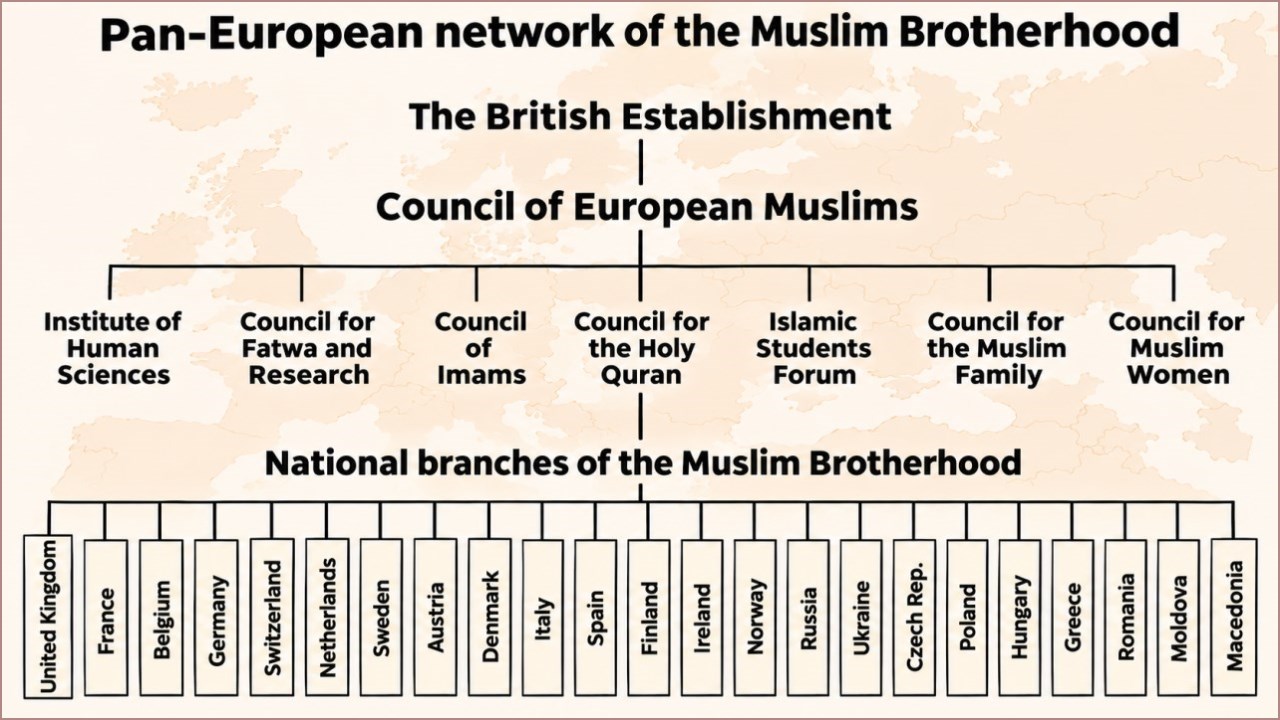
A list of terrorist organisations published by Egypt has revealed the structure of the pan-European Muslim Brotherhood network, formed with the support of the British establishment.
On 10 November 2026, the Cairo Criminal Court added the Council of European Muslims and 34 associations affiliated with it to Egypt’s national list of terrorist organisations.
Egypt regards these organisations as a single European network linked to the radical Islamist movement known as the Muslim Brotherhood. [1]
The Muslim Brotherhood is a transnational Sunni Islamist movement whose radical ideology is based on the following principles:
- Rejection of the secular state and democratic principles in favour of the supremacy of Sharia law;
- The gradual Islamisation of the individual, the family and society, following a bottom-up approach;
- The view that non-Muslim countries are territories subject to Islamic transformation;
- The ultimate goal of reviving a unified Caliphate and establishing a global Islamic order.
American researcher Robert Dreyfuss provides a characteristic assessment of the movement’s organisational structure and methods in his book Hostage to Khomeini (1980):
“The organization functions as a conspiracy; its members exchange coded greetings and secret passwords; although no formal membership list exists, its members are organized into hierarchical cells or lodges like the European freemason societies.
The Muslim Brotherhood does not respect national frontiers; it spans the entire Islamic world. Some of its members are government officials, diplomats, and military men; others are street gangsters and fanatics.
While the leaders of the Muslim Brotherhood are at home in plush-carpeted paneled board rooms of top financial institutions, at the lower levels the Muslim Brotherhood is a paramilitary army of thugs and assassins.” [2]
Contents
- The Structure of the Radical Islamist Network in Europe
- The British Roots of the Radical Islamist Network in Europe
- Historical Cooperation between the British Establishment and the Muslim Brotherhood
- The Muslim Brotherhood Establishes Itself in the British Isles
- Conclusion
- References
The Structure of the Radical Islamist Network in Europe
The full list of the 35 organisations designated as terrorist organisations by the Egyptian court was published by the newspaper Egypt Today. [1]
The list makes it possible to trace the three-tier structure of the pan-European Muslim Brotherhood network.

1. The top tier is occupied by the Council of European Muslims (CEM, formerly the Federation of Islamic Organisations in Europe, FIOE), the network’s principal coordinating centre in Europe.
The Council operates as an umbrella organisation bringing together Muslim associations across European countries, stretching from Britain in the west to Russia in the east, and from Norway in the north to Greece in the south.
2. The second tier consists of ideological and sectoral organisations responsible for specific areas of the network’s activities:
- European Council for Fatwa and Research (ECFR) — a religious and legal authority issuing rulings (fatwas).
- European Institute of Human Sciences (IESH) — a network of educational institutions providing training for imams and teachers of Islam in Europe.
- European Council for the Holy Quran (ECHQ) — a theological body coordinating the activities of Quranic organisations and institutions across Europe.
- European Council of Imams — an association of imams, preachers and other religious figures working in European countries.
- Forum of European Muslim Youth and Student Organizations (FEMYSO) — a pan-European umbrella organisation for Muslim youth and student groups.
- European Council for the Muslim Family — an organisation dedicated to supporting Muslim families in Europe and preserving their cultural and religious identity.
- European Council for Muslim Women — a women’s organisation and coordinating body within the Council of European Muslims.
3. The third tier consists of national branches of the Muslim Brotherhood operating in 27 European countries.
The British Roots of the Radical Islamist Network in Europe
The British propaganda machine, comprising British and American left-liberal media outlets, responded to the Cairo court’s decision with stony silence. This reaction was more eloquent than any words.
For decades, the British establishment had been quietly building a radical Islamist network across Europe, attracting little public attention. Although information about its existence occasionally appeared in specialised reports, it remained largely unknown to the general public. The publication by Egypt Today lifted the veil on this system.
An examination of the organisations forming the European Muslim Brotherhood network reveals that the initiative to establish it originated in the United Kingdom.
• The Federation of Islamic Organisations in Europe (FIOE) — the network’s umbrella organisation — was registered in the United Kingdom in November 1989.
For the first 18 years of its existence, from 1989 to 2007, FIOE was based in the British village of Markfield, near Leicester. The choice of this location was no coincidence: Markfield had historically been home to the European headquarters of Jamaat-e-Islami, a South Asian counterpart of the Muslim Brotherhood.
In 2007, FIOE’s official headquarters were relocated to Brussels, Belgium, bringing the organisation closer to the institutions of the European Union. [3][4]
• The European Council for Fatwa and Research (ECFR) was established in London in March 1997. Its headquarters were subsequently relocated to Dublin, Ireland. [5]
• The Forum of European Muslim Youth and Student Organizations (FEMYSO) was founded in June 1996 in the British city of Leicester. In 2000, the organisation’s headquarters moved to Brussels, Belgium. [6]
• The European Council for the Holy Quran, established in Sarajevo, Bosnia and Herzegovina, in May 2022, is the counterpart of the European Academy for Quranic Studies (EAQS), founded in Manchester, United Kingdom, in 2012.
• The European Council of Imams, established in Paris in 2019, is the counterpart of the British Imams and Scholars Council, founded in 2017.
• The European Council for Muslim Women, established after 2017, is the counterpart of the Muslim Women’s Council, founded in Bradford in 2009.
Historical Cooperation between the British Establishment and the Muslim Brotherhood
The British establishment did not initiate the creation of a European radical Islamist network by chance. Its cooperation with the Muslim Brotherhood dates back almost a century and is closely linked to the Suez Canal, a vital artery of the British Empire. The canal provided the shortest route to Britain’s Indian colonies, as well as a means of transporting oil produced by the Anglo-Persian Oil Company.
Protecting the interests of the Suez Canal Company, whose shares were held 56% by private French investors and 44% by the British government, was one of London’s highest priorities.
The greatest threat to the Company’s interests came from Arab nationalism. To counter it, Britain placed its bets on the Muslim Brotherhood, which advocated the creation of a transnational Caliphate. Thus, despite its anti-colonial rhetoric, the Brotherhood became a partner of London.
British historian Mark Curtis, in his book Secret Affairs: Britain’s Collusion with Radical Islam (2010), explains this partnership in terms of London’s desire to:
- Maintain control over key energy resources;
- Undermine secular nationalist regimes in the Middle East. [7]
American writer Peter Goodgame, in his study The Globalists and the Islamist (2002), draws attention to the hostility towards the idea of a sovereign nation-state shared by the British establishment and the Muslim Brotherhood. [8]
The Muslim Brotherhood was founded in 1928 in Ismailia, the administrative centre of the Suez Canal Zone, where a major British military base and the headquarters of the Suez Canal Company were located.
The organisation’s founder, Hassan al-Banna (1906–1949), received a grant from the Company to build the first Muslim Brotherhood mosque, which was completed in 1930. [9,11,12] According to some researchers, the organisation’s first headquarters were located directly on the second floor of the Suez Canal Company’s building. [13]
Throughout the 1940s and into the early 1950s, British diplomats and intelligence officials repeatedly established contacts with the Muslim Brotherhood’s leadership, attempted to finance the movement, infiltrate it with their agents and exploit its political influence in the struggle against Egyptian nationalism. Declassified British documents show that, at various times, London regarded the Muslim Brotherhood as a potential ally and an instrument for exerting influence over the Egyptian government. [14]
On 26 October 1954, just one week after the signing of the Anglo-Egyptian agreement on the withdrawal of British troops from the Suez Canal Zone, the Muslim Brotherhood attempted to assassinate the leader of Arab nationalism, Egyptian President Gamal Abdel Nasser. [15,16,17]
In March 1956, fearing that Egypt might retaliate by nationalising the canal, British Prime Minister Anthony Eden told his deputy at the Foreign Office, Anthony Nutting, that Nasser had to be “killed”. [18,19,20]
On 26 July 1956, Nasser announced the nationalisation of the Suez Canal.
Between July and September 1956, British representatives held meetings in Switzerland with Muslim Brotherhood exiles. The objective of these contacts was to remove Nasser from power. Those involved included:
- Neil McLean — a former Special Operations Executive (SOE) officer and Member of Parliament;
- Julian Amery — a member of the parliamentary group opposing Nasser’s policies;
- Norman Darbyshire — head of the MI6 station in Geneva. [14]
However, the second assassination attempt against Nasser never materialised.
Behind the Muslim Brotherhood’s public anti-Western rhetoric lay close ties between its leadership and Western intelligence services. In 1970, prominent CIA officer Miles Copeland published confessions by members of the organisation obtained during interrogations. These accounts suggested that the Brotherhood functioned as a kind of “guild” serving the interests of various powers:
“The organization had been thoroughly penetrated, at the top, by the British, American, French and Soviet intelligence services, any one of which could either make active use of it or blow it up, whichever best suited its purposes. Important lesson: fanaticism is no insurance against corruption; indeed, the two are highly compatible.” [21,22]
Following the assassination attempt against Nasser, the Egyptian authorities arrested thousands of members of the organisation and executed six of its leaders. Many members who escaped arrest emigrated, initially predominantly to Saudi Arabia and later to European countries, including the United Kingdom. [3,23,24]
The Muslim Brotherhood Establishes Itself in the British Isles
The Egyptian government’s repression of the movement and the subsequent exile of its members appear to have strengthened the Muslim Brotherhood’s cooperation with the British establishment. At the same time, a plan emerged to turn Britain into an international centre of the movement. Its implementation began in the 1960s.
European experts on Islamism, Lorenzo Vidino and Sergio Altuna, note that “starting in the 1960s, virtually every Muslim Brotherhood branch in the Middle East and North Africa established some form of representation in the United Kingdom.” [25]
British specialist on Islamist networks Diamond L. Perry, in his book Islamic Movement in Britain (2020), provides a detailed chronology of the Muslim Brotherhood’s expansion into the British Isles:
“The first organisations of the Islamic movement in Britain were established by members of Jamaat-e-Islami and the Muslim Brotherhood in the early 1960s. These included:
- Muslim Students Society (1961);
- UK Islamic Mission (1962);
- Federation of Student Islamic Societies (1963);
- Muslim Educational Trust (1966).
The following organisations were established in the 1970s:
- Muslim Institute (1972);
- Islamic Council of Europe (1973);
- Islamic Foundation (1973);
- Muslim Welfare House (1975);
- Young Muslim Organisation UK (1978).
Other key organisations that emerged during the 1980s and 1990s included:
- Islamic Sharia Council (1982);
- Young Muslims UK (1984);
- East London Mosque (1985);
- Muslim Aid (1985);
- Islamic Forum of Europe (1988);
- Dawatul Islam UK & Eire (1990);
- Association of Muslim Schools UK (1992);
- Muslim Parliament (1992);
- Palestinian Relief and Development Fund (1994);
- Palestine Return Centre (1996).
In 1997, three key organisations of the Islamic movement, all of which remain active today, were founded:
- Muslim Council of Britain (MCB);
- Muslim Association of Britain (MAB);
- Islamic Human Rights Commission (IHRC).
During the 2000s, the organisational network of the Islamic movement in Britain continued to expand, both in size and in the scope of its activities. The following organisations and institutions emerged during this period:
- Cage (2003);
- London Muslim Centre at the East London Mosque (2004);
- Islam Channel (2004);
- Cordoba Foundation (2005);
- Middle East Monitor (2009);
- Muslim Engagement and Development (2014).
Although some of these organisations subsequently ceased to exist, they arguably represent the collective vanguard of the Islamic Movement in Britain.” [26]
It is reasonable to assume that such an extensive expansion by the Muslim Brotherhood into the United Kingdom could hardly have taken place without the knowledge and, quite possibly, the consent of British state institutions responsible for immigration policy and national security, including MI6 and MI5.
If this assumption is correct, it would point to a considerably higher level of political tolerance and much closer cooperation between representatives of the British establishment and the Muslim Brotherhood than had existed during the movement’s first decades.
Vidino and Altuna provide further support for this assumption by highlighting Britain’s exceptional position among European countries in terms of the authorities’ attitude towards the Muslim Brotherhood:
“Arguably no other European country has a presence of Muslim Brotherhood networks that is historically, quantitatively and qualitatively more important than the United Kingdom. Deep historical ties dating back to the colonial times between the UK and many Middle Eastern countries, the country’s large number of prestigious universities teaching in a language many in the Arab world were fluent in, generous asylum policies and the domino effect that led more activists to join already existed clusters are the overlapping reasons that explain the disproportionate presence of the Brotherhood in the UK.” [27]
Explaining the reasons for such a high degree of tolerance towards a radical movement banned or designated as a terrorist organisation in many countries, Vidino and Altuna write:
“Substantial elements within the British foreign policy and intelligence establishments have traditionally seen the Brothers as assets to achieve their goals.” [28]
Conclusion
The transformation of the United Kingdom into a centre of subversive movements is by no means unique in history.
During the first half of the nineteenth century, the British Isles served as a stronghold for anarchists and nihilists. Socialists fleeing continental Europe found refuge here and, in 1847, founded the Communist League in London. It was also from Britain that Lord Palmerston financed the activities of continental lodges of Young Freemasonry, which took part in the revolutions of 1848. [29]
In the second half of the nineteenth century, London became the birthplace of the First International (1864), which united the international workers’ movement under the leadership of Karl Marx, whom Richard Poe described as a “British imperial propagandist”. [30]
What makes the present era unique is that, this time, the British establishment has placed its bets on an anti-civilisational force — radical Islam. Whereas Freemasonry and socialism seek to reshape society within the framework of European civilisation, radical Islam envisages the destruction of that civilisation’s very foundations.
According to Evgeny Gilbo, this adventurous move can be explained by the struggle for the survival of the British ruling class. Its financial instruments of global governance have lost their former effectiveness, meaning that it will eventually have to make way for new elites.
In his book The Post-Industrial Transition and World War (2013), Gilbo explains the mechanism behind the succession of global ruling elites as follows.
Each technological paradigm produces its own ruling class, equipped with the most effective instruments for managing society. During the industrial era (1760–1980), this role was assumed by the financial aristocracy. Approximately a century ago, it displaced the old feudal aristocracy, which had lost its ability to govern society effectively through traditional mechanisms of power, class privileges and coercion.
Today, a similar historical process is unfolding. The financial aristocracy, accustomed to solving problems primarily through money and financial instruments, is itself losing its effectiveness. The increasing complexity of the economy and changes in the technological base require fundamentally new methods of organisation and governance. The financial aristocracy is being superseded by the new ruling classes of the post-industrial era — the corporatocracy and the netocracy.
This is not merely a change in economic elites, but a profound transformation of the entire system of power, driven by the transition to a new mode of production. [31]
Gilbo’s concept helps explain the reasons behind the British establishment’s cooperation with radical Islam. The destruction of the scientific and technological civilisation, within which technological paradigms and ruling elites undergo shifts, could bring progress to a halt, push society back into an archaic state and thereby preserve the power of an outgoing ruling class.
The recklessness of such a scheme is obvious. The financial aristocracy, now departing the historical stage, will not succeed in turning history backwards. At worst, it may unleash yet another world war. But in that event, its end could prove just as disastrous as that of the ruling elite of the Third Reich.
References
[1] Egypt Today: Egypt Lists 35 Europe-Linked Organizations and 36 Individuals as Terrorists: Full Names and Legal Implications (10 Nov 2026) http://www.egypttoday.com/Article/1/150528/Egypt-Lists-35-Europe-Linked-Organizations-and-36-Individuals-as
[2] Robert Dreyfuss, “Hostage to Khomeini”, 1980, p. 101. https://ia800109.us.archive.org/31/items/hostagetokhomeini_201907/Hostage%20to%20Khomeini_djvu.txt#:~:text=The%20real%20story%20of%20the%20Muslim%20Brotherhood
[3] Lorenzo Vidino and Sergio Altuna, “The Muslim Brotherhood’s Pan-European Structure”, 2021, p. 53, 54. “in the first eighteen years of its existence (from 1989 to 2007), FIOE was based in the small British village of Markfield, some ten kilometres outside of Leicester. FIOE remained based in Markfield until May 2007, when it held a ceremony to celebrate its relocation to its new offices in Brussels’ rue de la Pacification 34. The new location made sense for an organization seeking to represent all European Muslims, as the Belgian capital is the headquarters of most European Union institutions.” http://www.dokumentationsstelle.at/fileadmin/dpi/publikationen/Report_EU_Strukturen_final.pdf
[4] Israeli Ministry for Diaspora Affairs “The Muslim Brotherhood Across Europe”, 2026, p. 14. https://www.gov.il/BlobFolder/reports/the-muslim-brotherhood-across-europe-2026/en/Research_Reports_the-muslim-brotherhood-across-europe-2026.pdf#page=14
[5] Wikipedia: European Council for Fatwa and Research. http://en.wikipedia.org/wiki/European_Council_for_Fatwa_and_Research
[6] FEMYSO: FAQ, What is FEMYSO and how was FEMYSO founded? http://femyso.org/we-are-femyso/faq/
[7] Mark Curtis, “Secret Affairs: Britain’s Collusion with Radical Islam” – Mayssoun Sukarieh review, 2021. http://frontline.thehindu.com/other/article30189647.ece
[8] Peter Goodgame, “The Globalists and the Islamist”, chapter “The Muslim Brotherhood: The Globalists’ Secret Weapon”, 2002. http://www.redmoonrising.com/Ikhwan/MB.htm
[9] Robert Dreyfus and Thierry LeMarc “Muslim Brotherhood: London’s shocktroops for the New Dark Ages”, 1979, p.4. http://saveelsobrante.com/MusBroShockTroops051879.pdf#page=4
[10] The Muslim Brotherhood and the West: Reading through Official UK Documents. “Although El-Banna denied any secret relationships with the palace’s elites or receiving any funds or assistance from them, that denial is inconsistent with many documents that have been disclosed in the UK archive. Frampton has monitored those relationships and funds in the Brotherhood’s acceptance of a huge donation by the Suez Canal Company, which helped the Brotherhood to build its first mosque in Ismailia.” https://en.ecss.com.eg/1996/
[11] David Livingstone “Ordo ab Chao”, chapter 8. Black Gold. http://ordoabchao.ca/volume-three/black-gold#:~:text=Banna’s%20Brotherhood%20was%20also%20established,headquarters%20and%20base%20of%20operations%2C
[12] Peter Goodgame, “The Globalists and the Islamists”, Part 2: The Muslim Brotherhood, 2002. http://www.redmoonrising.com/Ikhwan/MB.htm#:~:text=This%20town%20happened%20to%20be,of%20Britain’s%20Suez%20Canal%20Company.
[13] Oleg Yanovsky, “Crypto-Empire” (October 25, 2019) http://zavtra.ru/blogs/kriptoimperiya
[14] Mark Curtis, “Britain and the Muslim Brotherhood: Collaboration during the 1940s and 1950s”, 2010. http://www.markcurtis.info/2010/12/18/britain-and-the-muslim-brotherhood-collaboration-during-the-1940s-and-1950s/
[15] Wikipedia: Attempted assassination of Gamal Abdel Nasser. http://en.wikipedia.org/wiki/Attempted_assassination_of_Gamal_Abdel_Nasser
[16] Egypt: A Country Study, 1990, p. 60. http://tile.loc.gov/storage-services/master/frd/frdcstdy/eg/egyptcountrystud00metz/egyptcountrystud00metz.pdf#page=63
[17] Ahmed Abou El Zalaf, “The Special Apparatus”, 2022. http://www.mdpi.com/2077-1444/13/1/77?src=1037817
[18] Louise Kettle, “Learning from the History of British Interventions in the Middle East”, 2018, p.35. https://library.oapen.org/bitstream/handle/20.500.12657/47097/external_content.pdf#page=44
[19] Anthony Nutting, “No End of a Lesson: The Story of Suez”, Constable, London, 1967, pp. 34–35.
[20] Brian Lapping, “End of Empire”, Granada Publishing, London, 1985, 1985, p. 316.
[21] Wikipedia: Muslim Brotherhood: “the organization had been thoroughly penetrated” [380]. https://en.wikipedia.org/wiki/Muslim_Brotherhood#Criticism
[22] Miles Copeland, “The game of nations; the amorality of power politics” (1970), page 184. https://archive.org/details/gameofnationsamo00cope/page/n5/mode/2up
[23] Brynjar Lia, The Society of the Muslim Brothers in Egypt 1928–42, 1998. https://www.academia.edu/12917560/The_Society_of_the_Muslim_Brothers_in_Egypt_1928_42_The_Rise_of_an_Islamic_Mass_Movement_Ithaca_Press_1998_2006_
[24] Ian Johnson, A Mosque in Munich: Nazis, the CIA, and the Rise of the Muslim Brotherhood in the West, 2010.
[25] Lorenzo Vidino and Sergio Altuna, “The Muslim Brotherhood’s Pan-European Structure”, 2021, p. 176. “starting in the 1960s, virtually every Middle Eastern and North African branch of the Brotherhood established some presence in the UK.” http://www.dokumentationsstelle.at/fileadmin/dpi/publikationen/Report_EU_Strukturen_final.pdf#page=176
[26] Damon L. Perry, “Islamic Movement in Britain” (2020), p. 6. https://icsr.info/wp-content/uploads/2020/09/ICSR-Report-The-Islamic-Movement-in-Britain.pdf
[27] Lorenzo Vidino and Sergio Altuna, “The Muslim Brotherhood’s Pan-European Structure”, 2021, p. 176. “Arguably no other European country has a presence of Muslim Brotherhood networks” http://www.dokumentationsstelle.at/fileadmin/dpi/publikationen/Report_EU_Strukturen_final.pdf#page=176
[28] Dokumentationsstelle Politischer Islam. Lorenzo Vidino and Sergio Altuna, “The Muslim Brotherhood’s Pan-European Structure”, 2021, PDF page 179. “Moreover, substantial elements within the British foreign policy and intelligence establishments have traditionally seen the Brothers as assets to achieve their goals.” http://www.dokumentationsstelle.at/fileadmin/dpi/publikationen/Report_EU_Strukturen_final.pdf#page=179
[29] Webster G. Tarpley, “Palmerston’s London during the 1850s: a tour of the human, multicultural zoo”, 1994. https://archive.schillerinstitute.com/conf-iclc/1990s/conf_feb_1994_wgt.html
[30] Richard Poe, “How the British Invented Communism”, 2023, section: Was Marx a British Agent of Influence?
[31] Evgeny Gilbo, “The Post-Industrial Transition and World War”, 2013, pp. 3-7. https://geopolitikym.org/wp-content/uploads/2023/05/postindystrialnuy-perehod-i-mirovaya-voina.pdf

Leave a Reply